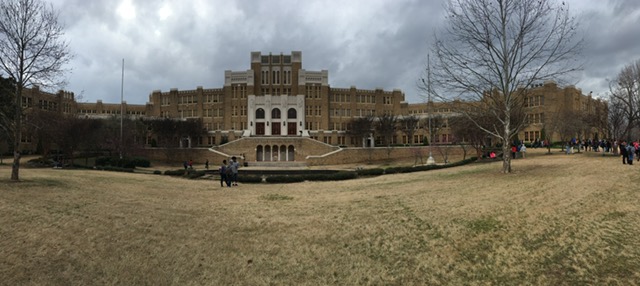
Monday afternoon we decided to spend a little more time in town and one of the destinations on our “if we have enough time” list was Little Rock Central High School, the site of the integration of 9 African American students into a white school in 1957. The school is still very much in use, so we visited the Little Rock Central High School National Historic Site Visitor Center which is right across the corner.
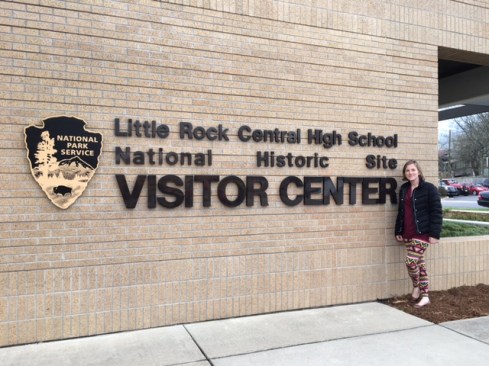
We spent about an hour and a half there and immediately got lost in time. I must have read, seen, and heard more history and thought provoking quotes than my brain could really process all at once, because I find myself still turning things over in my mind.
If you don’t know the story of the Little Rock 9 (I admit I was only vaguely familiar), it’s an incredible story of courage and leadership during the civil rights movement. You can read more about it here.
The museum site itself is fairly small but packed with incredible primary sources: documents, photographs, sound clips, video clips, newspaper articles, autobiographical stories of the Little Rock 9 and others.
We began our time at the museum viewing the 20 minute film offered every 30 minutes in a separate screening room. The movie depicted not only the story of the Little Rock 9, but also stories of current civil rights struggles. There were so many times we actually made connections to what we’d been focusing on at Heifer earlier that day- one person joining in an effort toward long-term, positive changes! Sometimes you might be the first one to take the small step that becomes a movement. The video combined history with current events in a way that made us both thoughtful of our own roles in society today- what problems do we see? Which ones do we pay attention to? Even problems that don’t seem like our problems can become problems that matter to us. (JUST LIKE we learned at Heifer Village!)
“Your origins are irrelevant to where you’re able to go.” –One of the Little Rock 9
Freshman students at Little Rock Central High School participate in a “memory project” where they interview older citizens about civil rights experiences in their lifetime. Those clips from the film were also fascinating. These interviews were published in a book, and of course we bought a copy in the gift shop.
These are just a few of the moving displays at the historical site. Some of the quotes and Americans featured tie in directly to our third grade social studies SOLs – Thomas Jefferson, the Declaration of Independence, Abraham Lincoln, Thurgood Marshall, Dr. Martin Luther King, Jr., Rosa Parks, and Cesar Chavez all were present.
“We the people” did not include everyone” was a large quote on the wall- one that we’ve been teaching in our elementary classrooms for years. Making the connection from past to present current civil rights struggles was a powerful experience that will continue to shape our classroom conversations. As we participate in a global community, we also need to keep in mind the realities of the situations in our own community and thoughtfully speak up and out when we see injustice anywhere in our world.
We hold these truths to be self-evident, that all men are created equal, that they are endowed by their Creator with certain unalienable Rights, that among these are Life, Liberty and the pursuit of Happiness. – Declaration of Independence, 1776
 Learn.Go.Serve.Lead